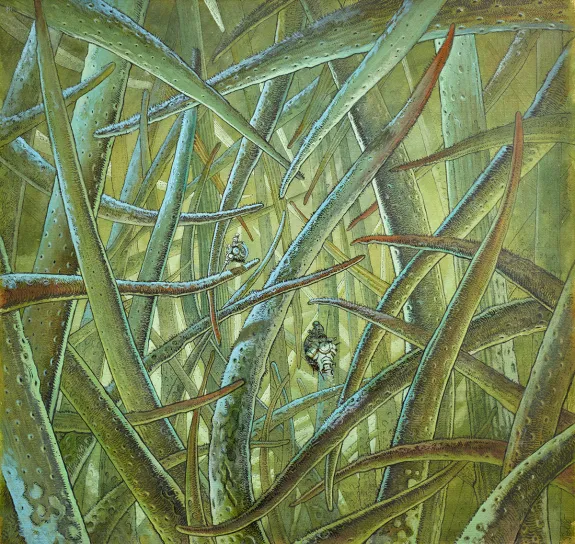
Enki Bilal
Topics :
- Science fiction
- Classical
- Occult
- Thriller
- Post apocalyptic
- Road Trip
The Visionary
Bilal is one of the most important comic artists and scriptwriters of his time. Born in 1951 in Yugoslavia to a Bosnian father and a Slovak mother, Enki Bilal arrived in Paris in 1960. In 1971, he won a comic strip contest for the magazine Pilote, then a hotbed of the French new comic art movement. There he published his first story: Le Bol maudit (The Cursed Bowl, 1972). His meeting with Pierre Christin in 1975 marked the beginning of the first phase of his career, during which he expressed himself through powerful artwork addressing strong political themes. This resulted in the Légendes d’aujourd’hui trilogy: La Croisière des oubliés (1975), Le Vaisseau de pierre (1976), and La Ville qui n’existait pas (1977). In the wake of these events, Bilal and Christin, acting as visionaries, chronicled the end of a fading century marked by the fall of the Spanish fascist regime and the collapse of Soviet communism: this resulted in the diptych Les Phalanges de l’ordre noir (The Phantoms of the Black Order, 1979) and Partie de chasse (The Hunting Party, 1983).
At the same time, Bilal contributed to the emergence of a science-fiction comic art movement led by Métal Hurlant. This resulted in Exterminateur 17 (Exterminator 17, 1979) and, above all, the Nikopol trilogy: with La Foire aux Immortels (1980), La Femme Piège (1986), and Froid Équateur (1992), he created a universe of exceptional evocative power. It was with this trilogy that he began working his pages in direct color—a revolutionary approach for the time—with an incomparable talent that earned him international recognition. Bilal then became a highly sought-after illustrator. Soon, the film industry turned to him. He created the set designs on glass for Alain Resnais’s La Vie est un roman (1982) and also designed the poster for Mon oncle d'Amérique (1984). He conducted graphic research for Le Nom de la rose, Jean-Jacques Annaud’s film based on Umberto Eco’s novel (1986). The ultimate accolade: in 1986, Bilal was awarded the Grand Prix de la Ville d’Angoulême, the highest honor for a comic artist in France. He was also elevated to the rank of Knight of the National Order of Merit and became an Officer of the Order of Arts and Letters.
In recent years, his career has been divided between comics —with the Tétralogie du Monstre (The Monster Tetralogy, 1998–2007) and the Coup de sang (A Rush of Blood) trilogy (2009–2014)— the visual arts, including set and costume design for Prokofiev’s Romeo and Juliet (1990) and Denis Levaillant’s opera O.P.A. Mia (1990), and film.
He has directed three movies: Bunker Palace Hotel (1989), Tykho Moon (1996), and Immortel (ad vitam)(2004), which have left their mark on the history of French cinema, both through their original aesthetic approach and the richness of the worlds they evoke. Bilal bridges the gap between comic art and the latest developments in contemporary art, where the breakdown of barriers between “low” art (comics) and “high” art is the norm. “If Enki Bilal has risen to the ranks of the cream of the crop in contemporary art, it is because he has been able to distance himself from his influences to create his own graphic universe,” as noted in Le Monde. His artwork has also been exhibited at the Louvre and the Musée des Arts et Métiers. According to L’Express, he is “along with Soulages and Buren, one of the most highly valued living French artists on the international market.” It is true that despite having sold millions of albums in dozens of languages (including English, Japanese, Chinese, Brazilian Portuguese, German, and Turkish), Bilal has succeeded in breaking comics out of their bubble by extending his universe onto screens and… onto walls.
In 2026, he opened the Fonds Enki Bilal in the heart of Paris, a space dedicated to the diverse forms of contemporary art, showcasing iconic artists of our time.
With La Foire aux Immortels (The Carnival of Immortals), Bilal laid the foundations for a fantasy universe that would soon be adapted for film and video games. His artistic transformation was complete: having become a master of direct color, he applied to comics the translucent effects of stained-glass painting that he had experimented with while designing the sets for Alain Resnais’s film, La Vie est un roman (Life is a Bed of Roses, 1983).
Didier Pasamonik
Pages and artworks from Enki Bilal See all


You will also like...
-
-
-
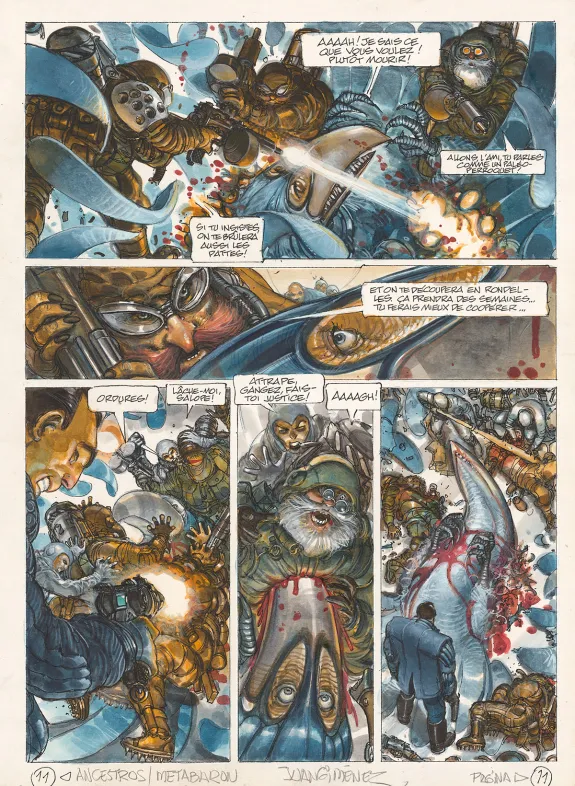
Original page n°11 with its first step
4 500 € -

-
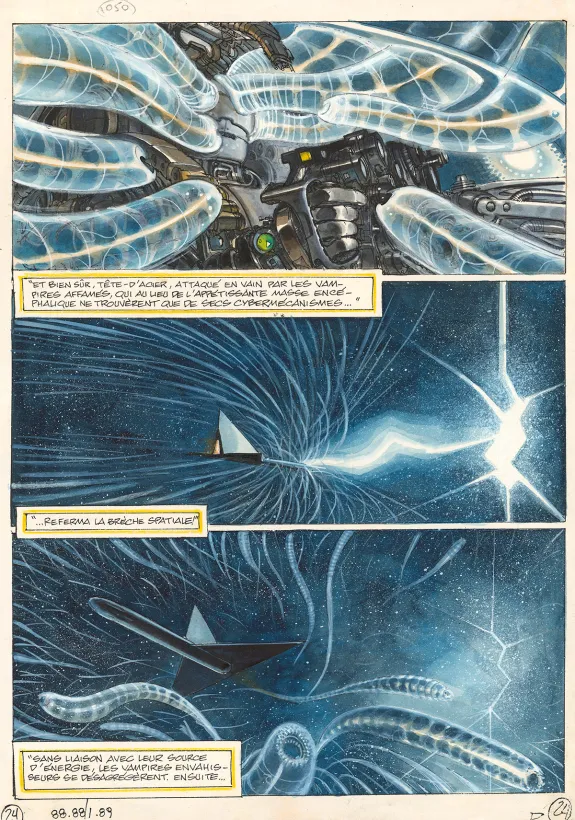
Original page 24 with its first step
6 900 € -